
Vehicle Identification
One of the first steps in restoring a car is identifying exactly what you have. It helps you find the right parts, specifications, and literature for your restoration. This page and the pages below it describe some ways to identify a car or truck from the Durant family.
In this section: Identifying the Year · Car Numbers and Factory Prefixes · Body Styles · Wheel Types · Radiator Badges
Two ways to start
Method 1: the body data plate
Find the body data plate. It is in the engine compartment, on the passenger side of the firewall. If the plate is intact it tells you the model of your car or truck, and the model and car number can be used to find the year. See Car Numbers and Factory Prefixes.
Method 2: detective work
If there is no body data plate, you will have to do more detective work. Collect as much of the following information as you can, then use this site and any other sources you can find to work out where your car or truck fits.
- engine type and serial number – located on a plate, typically on the left side of the engine
- engine block casting date
- engine head casting date
- engine number of cylinders
- engine – is there an air filter or an oil filter present
- transmission, number of forward speeds
- transmission – is it equipped with “free-wheeling”
- brakes – two wheel or four wheel
- brakes – two or three shoe
- brakes – internal or external
- wheels – wooden, steel, or wire
- wheels – number of rear wheels
- wheelbase (center of front axle to center of rear axle measurement)
- radiator badge type (different badges were used in different years)
- number of leaf springs (front and rear)
- length of leaf springs (front and rear)
A complete description
A complete description includes the make, model, year, and the other details that identify one particular car. It should include the following. Click an item to learn more about it.
| Item | What to record |
|---|---|
| Year | The year of production. It is not written anywhere on the car, so it can be hard to pin down. |
| Make | Durant, Star, Rugby, Flint, and so on. Usually easy to tell from the radiator badge and hubcaps. |
| Model | Each make came in several models, with different engines, chassis, and equipment. The model is usually on the body data plate, so if the plate is in good shape the model is easy to find. |
| Body style | Most models came in several body styles. The style is usually a matter of looking at the car, but if the body is missing or badly altered it may be impossible to tell. |
| Car number (vehicle serial number) | On the body data plate. Include the printed letter before the number: it shows the factory where the car was built. |
| Wheel type | Some cars offered optional wheels (wooden, steel disc, or wire), either with a particular model or as a separate option. See the model's fact sheet. |
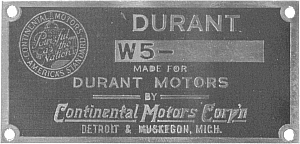
| Engine serial number | On an identification plate on the side of the engine. |
| Engine | The engine model, such as W-5 or 22A (almost all were made by Continental). It is usually the letters and numbers at the start of the engine serial number (W5-462683 is a W-5). See the Engine Catalog for which engine went in which make and model. |
| Engine block casting date | The date of manufacture is cast into the block. |
| Engine head casting date | The date of manufacture is cast into the cylinder head. |
So a sample car might be described as:
1929 Durant 40 De Luxe Roadster with wire wheels; car number T-8547; engine number W5-571126; block cast mm-dd-yy; head cast mm-dd-yy.
Once you have identified your car, please consider adding it to the registry.